


Art Nouveau - Revolution In Interior Design
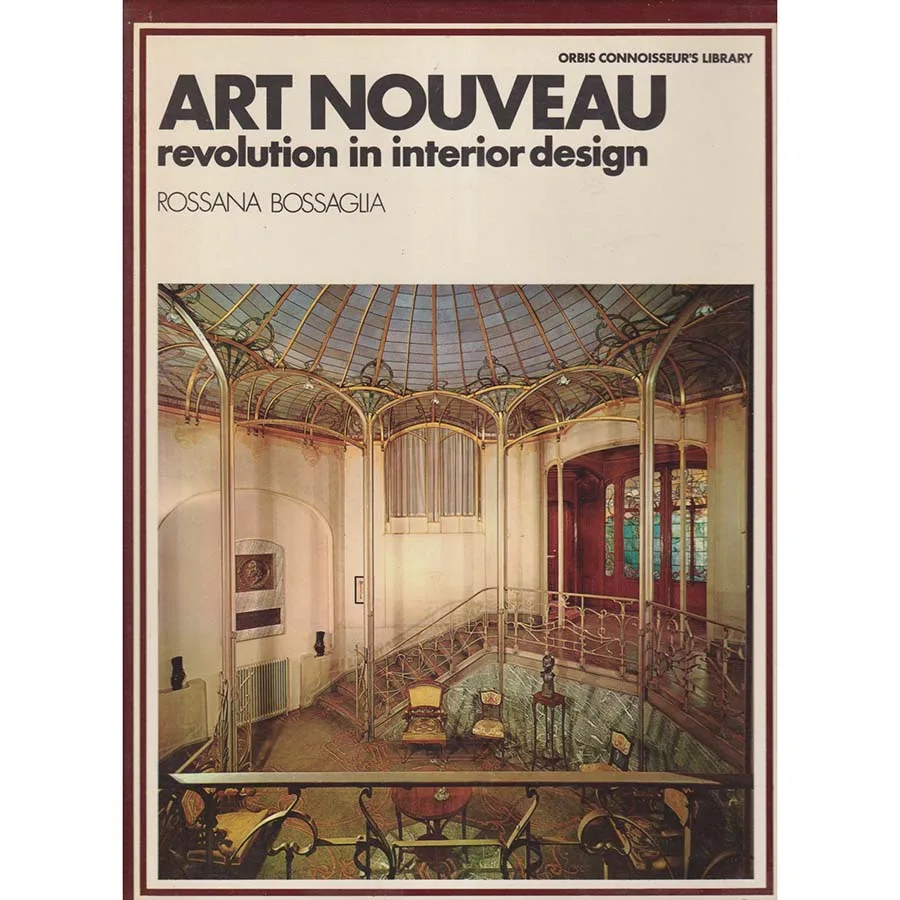
Publisher: Orbis Publishing
Format: Hardback
ISBN: 0856131288
Art Nouveau - Revolution in Interior Design by Rossana Bossaglia, published by Orbis Publishing in 1973, is a richly illustrated look at the moment when interior design collectively decided that straight lines had had quite enough attention and everything would be improved by curves, tendrils, flowers, insects and furniture that occasionally appears to be trying to grow.
Art Nouveau was not merely a decorative style. It was an attempt to rethink the entire visual environment, from architecture and furniture to glass, metalwork, ceramics, textiles and graphics. Rooms were no longer simply rooms. They became complete compositions in which walls, chairs, lamps and door handles were expected to participate in the same artistic conspiracy.
Bossaglia traces this transformation through the major designers, architects and decorative traditions associated with the movement, showing how Art Nouveau developed across Europe and beyond in a remarkable variety of regional forms. The result is a style that could be elegant, theatrical, organic, extravagant or occasionally just a little too enthusiastic about lilies.
This was the age of sweeping lines, stained glass, sinuous ironwork and furniture that often looked considerably more alive than the people sitting on it. Nature provided much of the inspiration, but nature as interpreted by designers who had clearly never believed that a plant should be permitted to remain quietly in a pot.
The book is especially interesting because Art Nouveau was always about more than ornament. Its leading figures wanted to break with historical imitation and create a modern style suited to a new century. The irony, of course, is that nothing dates quite as magnificently as something designed to look completely modern.
Yet that is exactly why it remains so appealing. Art Nouveau interiors possess a confidence and coherence that are difficult to reproduce. Every surface matters. Nothing is merely practical if it can also curve attractively, and no staircase should be allowed to remain structurally anonymous if it can instead sweep through the room like a botanical event.
Published in 1973, this volume is itself a product of a period when interest in Art Nouveau was being revived and reassessed. By then, the style had moved from being unfashionable old decoration to something worthy of serious art-historical study, which is generally what happens once enough people have thrown away the original examples.
The illustrations make this a particularly enjoyable book for anyone interested in interiors, furniture, architecture or decorative arts. It is the sort of volume that encourages prolonged browsing and occasional muttering about how much more interesting a radiator cover used to be.
There is also a certain pleasure in seeing an era when designers were allowed to be properly excessive. Modern interiors often aim for restraint, neutrality and surfaces that look as though nobody has ever lived near them. Art Nouveau took the opposite approach and asked why a room should be calm when it could instead contain wrought iron, coloured glass and a staircase resembling seaweed.
A strong choice for collectors of design books, decorative arts, architecture, furniture history and late nineteenth- and early twentieth-century visual culture, or anyone who believes minimalism would be substantially improved by adding a peacock.
Condition: Good. A sound used copy with normal signs of age and handling. Published in 1973, it has now acquired a certain retro-design status of its own, although thankfully without requiring the entire room to match.
ISBN: 0856131288.
A handsome and informative survey of one of the most distinctive movements in decorative design, full of interiors, objects and ideas from an age when even a lamp was expected to have artistic ambitions.
Sold by Crappy Old Books — where maximalism is welcome and beige is viewed with appropriate suspicion.
Keep browsing: See more Architecture books Other books by Rossana Bossaglia
